

Journal
How to Check Diamond Quality Before You Buy in India

Dhanteras: Friday, 6 November 2026 · Prices as on 16 October 2026
Dhanteras falls on Friday, 6 November 2026, less than three weeks away, and this is when many families start comparing diamond jewellery. This guide shows you how to check diamond quality before buying, using five simple checks: the 4Cs, the label, the grading report, the gold and the bill. It is a checklist, not a gift list.
Looking for gift ideas instead? See our Dhanteras 2026 diamond jewellery guide, or our Karwa Chauth gifts for your wife.
Why check before Dhanteras
Festive buying is often rushed. A few minutes with the spec sheet, the label and the paperwork tells you exactly what you are paying for, and the same checks work at any jeweller, not only ours.
1. Read the 4Cs on the spec sheet
Every diamond is described by the 4Cs: carat, colour, clarity and cut. A good jeweller writes them down for each piece. Here is how to read them; for the full explanation, see our guide to the 4Cs of diamonds.
Colour and clarity: what H-I and SI1-SI2 mean
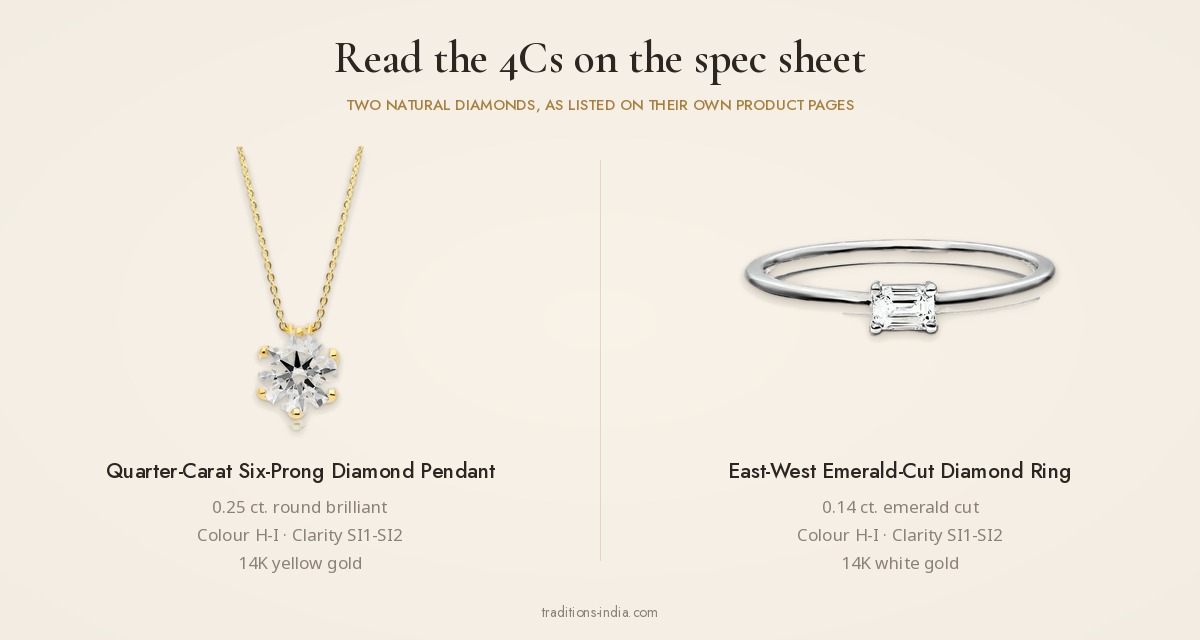
Colour is graded on a letter scale, where earlier letters are whiter. Clarity grades describe tiny natural inclusions; SI stands for “slightly included”. Look for a grade written as a range, such as H-I or SI1-SI2, on the spec sheet. For example, the Classic Quarter-Carat Six-Prong Diamond Pendant lists one 0.25 ct. round brilliant natural diamond, H-I in colour and SI1-SI2 in clarity, in 14K yellow gold.
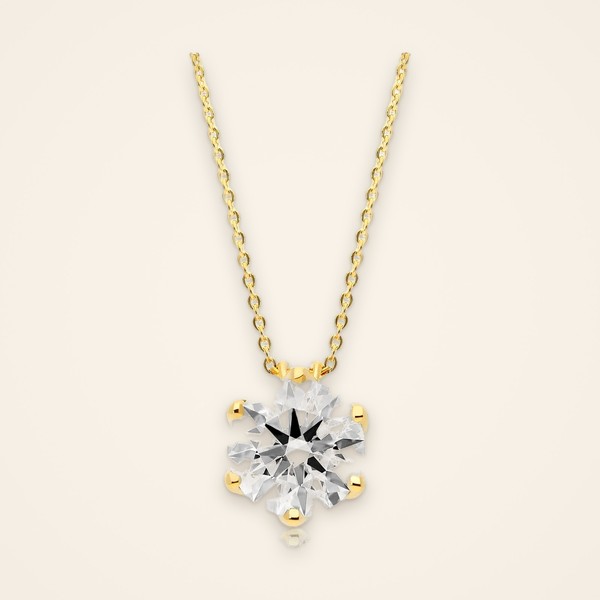
Classic Quarter-Carat Six-Prong Diamond Pendant
One 0.25 ct. round brilliant natural diamond, H-I colour, SI1-SI2 clarity, six-prong wave-edge basket, 14K yellow gold, 18-inch cable chain (adjustable to 16)
₹1,21,100 (as on 16 October 2026)
Cut and shape: why sparkle depends on cut
Shape is the outline, such as round or emerald; cut is how well the facets are arranged, and it decides how the stone handles light. A round brilliant is cut for sparkle. An emerald cut has long, flat step facets that give a calm, mirror-like flash instead. The Everyday East-West Emerald-Cut Diamond Ring shows this look with a single 0.14 ct. emerald-cut natural diamond, H-I and SI1-SI2, in 14K white gold.
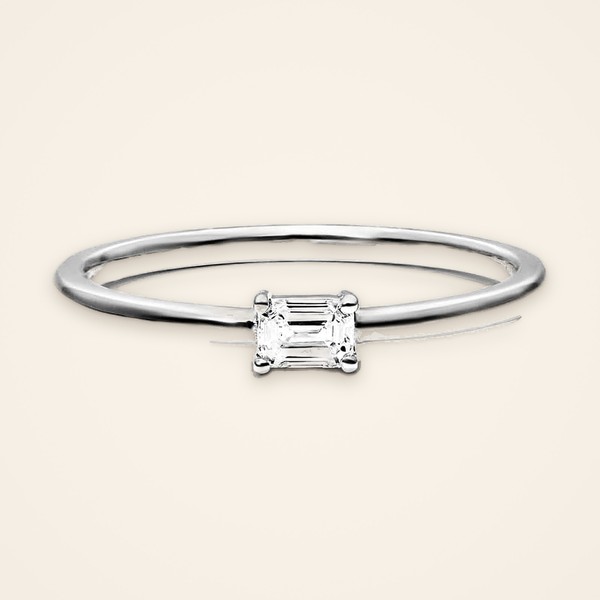
Everyday East-West Emerald-Cut Diamond Ring
One 0.14 ct. emerald-cut natural diamond, H-I colour, SI1-SI2 clarity, stackable solitaire, 14K white gold
₹66,800 (as on 16 October 2026)
Carat vs total carat weight (ct. tw.)
Carat is weight, not size. On pieces with many stones, the spec sheet gives a total carat weight (ct. tw.), which adds up every diamond in the piece. A 2 ct. tw. bracelet made of many small stones is very different from a single 2-carat stone, so always check the number of diamonds too.
2. Natural or laboratory-grown? Check the label
Natural and laboratory-grown diamonds are both real diamonds, and you cannot tell them apart by eye; it takes gemmological testing. That is why the label and the paperwork matter so much.
A new BIS standard, IS 19469:2025, deals with diamond terminology. Under it, the word “diamond” on its own means a natural diamond, and a laboratory-grown stone should be described in full as a “Laboratory-Grown Diamond”. If a label or bill only says “diamond”, ask whether the stone is natural.
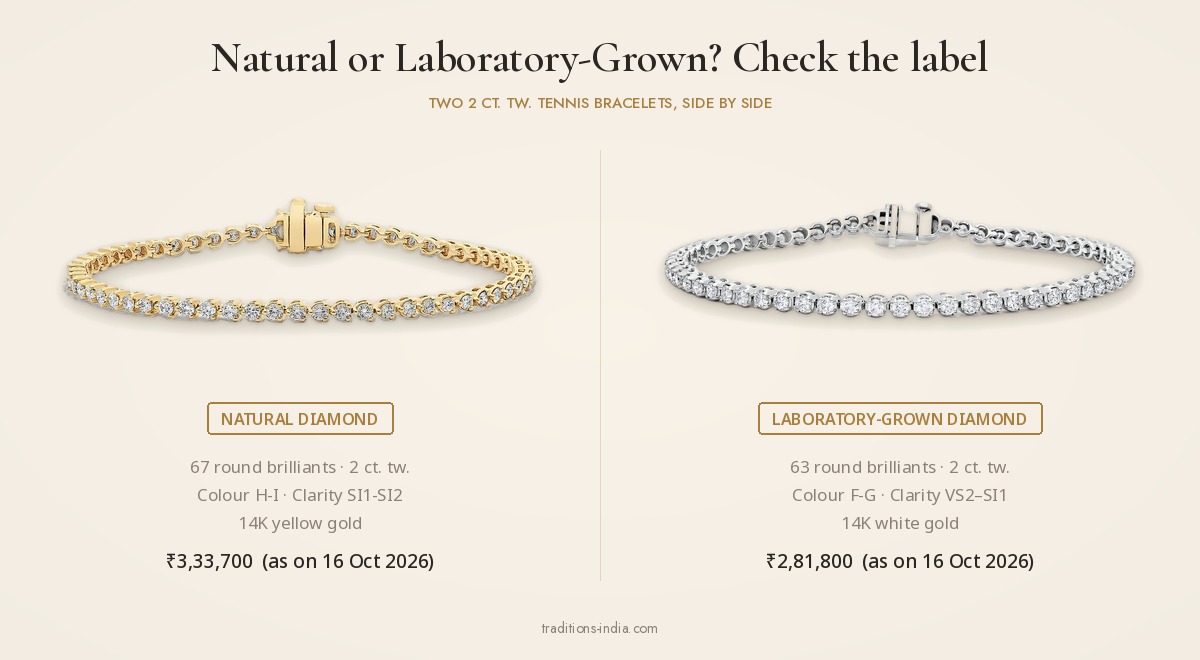
Here are two of our 2 ct. tw. tennis bracelets side by side. The Classic Basket-Set Two-Carat Tennis Bracelet holds 67 natural diamonds, H-I and SI1-SI2, in 14K yellow gold. The Classic Laboratory-Grown Diamond White Gold Tennis Bracelet holds 63 Laboratory-Grown Diamonds, F-G and VS2–SI1, in 14K white gold. Compare the grades, the metal and the price, and choose what matters to you.
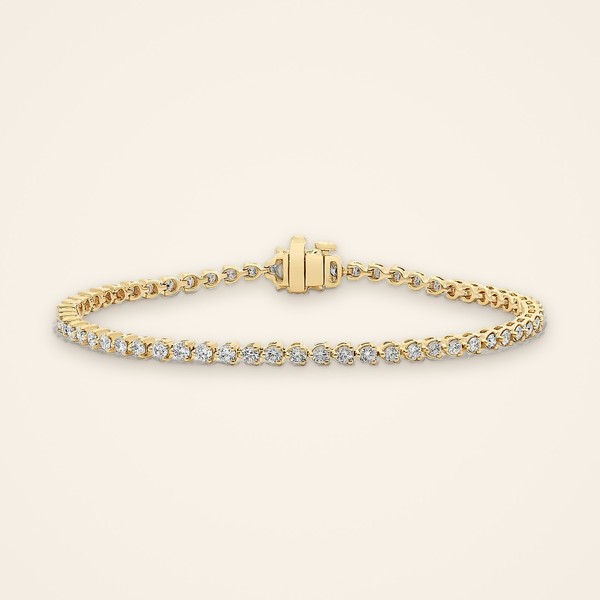
Classic Basket-Set Two-Carat Tennis Bracelet
67 round brilliant natural diamonds, 2 ct. tw., H-I colour, SI1-SI2 clarity, three-prong baskets, 14K yellow gold, 7 inches, box clasp with flower detail
₹3,33,700 (as on 16 October 2026)
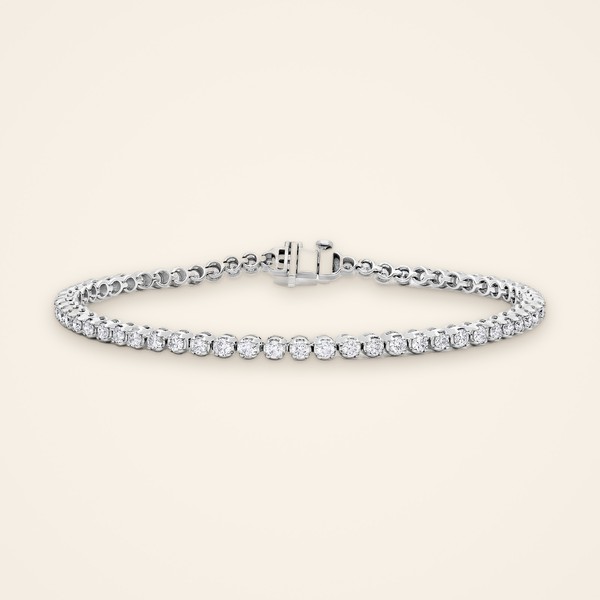
Classic Laboratory-Grown Diamond White Gold Tennis Bracelet
63 round brilliant Laboratory-Grown Diamonds, 2 ct. tw., F-G colour, VS2–SI1 clarity, four-prong setting, 14K white gold, 7 inches, box clasp
₹2,81,800 (as on 16 October 2026)
Our collection is mostly natural diamonds, and every laboratory-grown piece is clearly labelled “Laboratory-Grown Diamond”. You can see them all in our Laboratory-Grown Diamond collection, and read more in our post on laboratory-grown diamonds.
3. Grading reports: IGI and GIA
A grading report from an independent lab such as IGI or GIA records a stone’s weight, shape, measurements, colour and clarity, and states whether it is natural or laboratory-grown. To check one:
- Find the report number on the report (and, for many stones, inscribed on the girdle).
- Enter it on the lab’s own website: IGI’s “Verify Your Report” page or GIA Report Check.
- Match the details online to the paper report and to the stone in front of you.
At Traditions, GIA/IGI certification is available on request, depending on the piece. Ask us before you order. For more on the two labs, read Understanding GIA and IGI certification.
4. Check the gold: karat and BIS hallmark
The metal is part of the price, so check it too. 14K gold is 58.5% pure gold and 18K is 75%; the karat should be stamped on the piece and written on the bill. In India, a BIS hallmark on gold jewellery carries a six-digit HUID (Hallmark Unique Identification) code, which you can look up in the BIS Care app.
Remember that a hallmark covers gold purity only. It tells you nothing about the diamond. Our BIS hallmark reference, HM/C-8590112524, relates to gold only; it is not a certificate for any diamond.
5. What your bill should say
Your bill is your record. Before you pay, make sure it lists:
- Stone type: natural diamond, or Laboratory-Grown Diamond in full
- Number of stones and the total carat weight (ct. tw.)
- Colour and clarity grades
- Metal and karat, for example 14K yellow gold
- The grading report number, if the piece has one
- The return terms (read our return and refund policy before you order)
Your 60-second diamond checklist
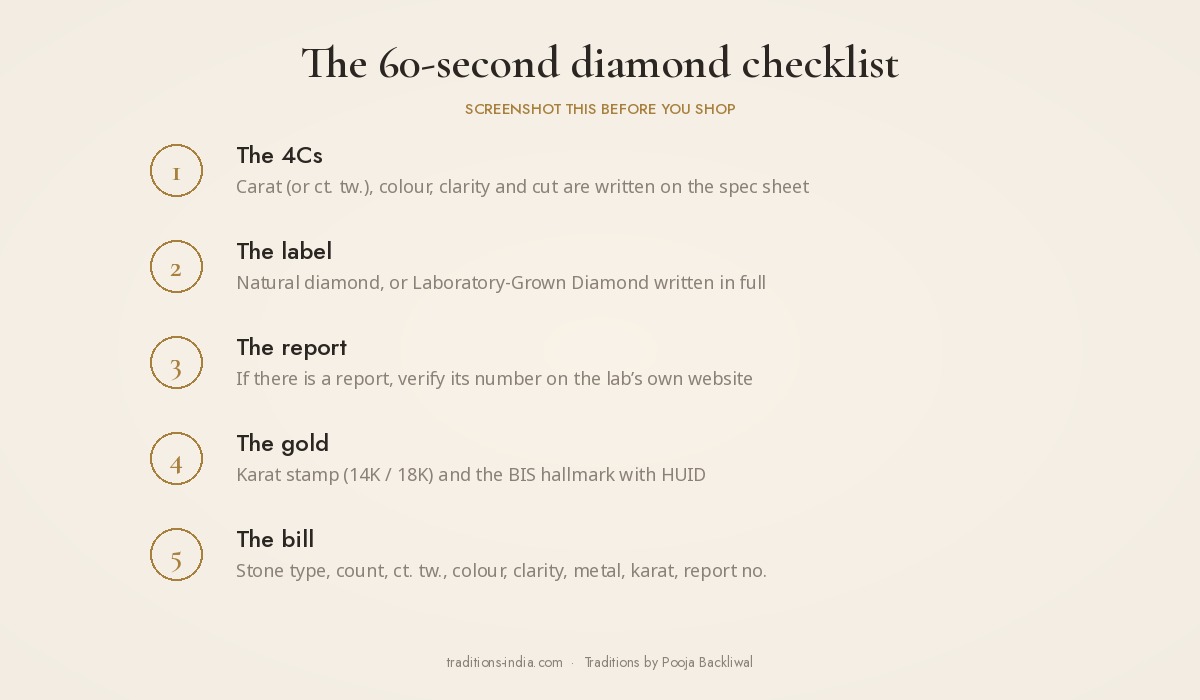
CHECK BEFORE YOU PAY
- ☐ The 4Cs: carat (or ct. tw.), colour, clarity and cut are written down.
- ☐ The label: natural diamond, or “Laboratory-Grown Diamond” in full.
- ☐ The report: if there is one, the number checks out on the lab’s own website.
- ☐ The gold: karat stamp, plus the BIS hallmark and HUID.
- ☐ The bill: every detail above, in writing.
Frequently asked questions
Can you tell a laboratory-grown diamond from a natural one by eye?
No. A laboratory-grown diamond is a real diamond, and telling it apart from a natural one needs gemmological testing. Rely on the label, the grading report if there is one, and what your bill says.
Is SI clarity good enough for jewellery?
Often, yes, especially for small and pavé-set stones in a setting, but it depends on the individual stone. Read each piece’s own clarity grade on its spec sheet and look at the piece before you buy.
How do I verify a diamond certificate?
Enter the report number on the grading lab’s own website, such as IGI’s report verification page or GIA Report Check, and match the weight, shape, colour and clarity on the report to the stone you are buying.
Does a BIS hallmark cover the diamond?
No. A BIS hallmark covers the purity of the gold only. It says nothing about the diamond’s quality or whether it is natural or laboratory-grown.
See the diamonds in person
If you would like to check a piece with us, book an appointment at our Connaught Place store in New Delhi, or browse our diamond pendants, diamond rings and diamond bracelets. For gift ideas by budget, see our Dhanteras 2026 diamond jewellery guide.
Prices as on 16 October 2026 and subject to change.